Selecting the right Torque Motor can shape an automation system’s accuracy, speed, and service life. In a robotic arm, a rotary table, or a semiconductor stage, the motor sits close to the load. That short mechanical path reduces backlash, vibration, and transmission losses. It also exposes every design mistake.
This guide examines 10 Best Torque Motors for Industrial Automation, comparing continuous torque, peak torque, thermal capacity, encoder compatibility, bearing strength, and control response. A motor that performs smoothly during a ten-second test may still overheat during an eight-hour production shift. That difference matters. So does the application’s cable routing, mounting stiffness, and emergency-stop behavior.
Motion-control specialist Dr. Kevin Craig has often stressed, “Good motion control begins with understanding the entire machine, not just the motor.” That principle remains useful here. A high-torque model cannot compensate for a flexible frame or poorly tuned servo loop. Likewise, a compact motor may look efficient but struggle when heat has nowhere to escape.
The selections below focus on practical industrial conditions, including repeated acceleration, dusty enclosures, tight positioning, and continuous cycling. Some rankings remain debatable. There is no universal winner. A direct-drive motor designed for cleanroom precision may be a poor choice for a heavy packaging axis. Engineers should verify manufacturer data, test the actual load, and leave thermal margin before making a purchase.
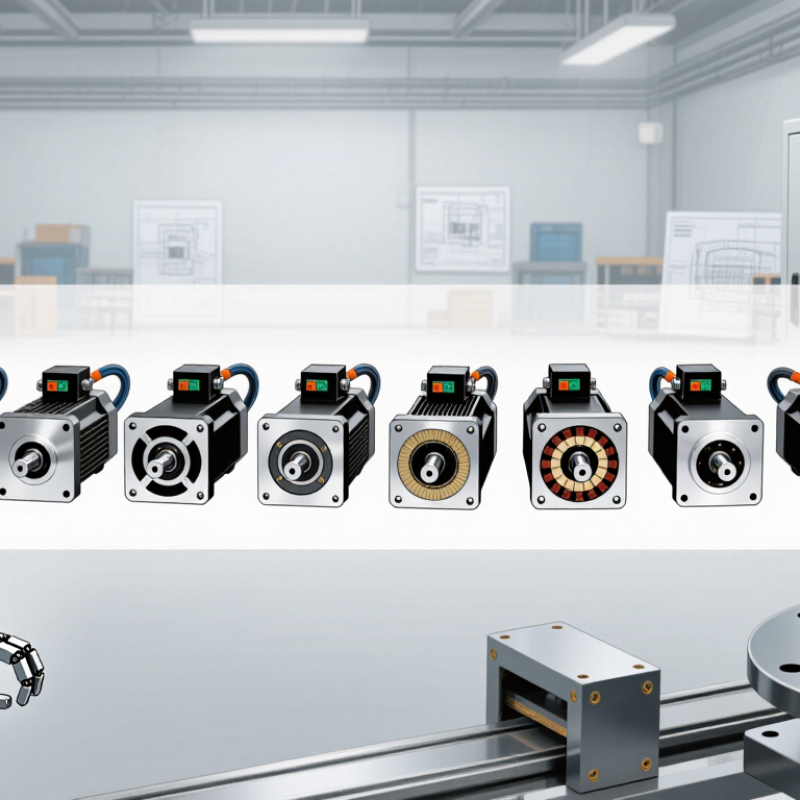
Torque Motor Basics: Direct Drive, Continuous Torque (N·m), and Speed (rpm)
10 Best Torque Motors for Industrial Automation?
Torque motors are built for direct drive, so they can move a load without a gearbox. This reduces backlash, mechanical noise, and maintenance points. The motor’s continuous torque rating, measured in N·m, matters more than a short peak value during normal production. A motor rated for 80 N·m continuously should not carry that load indefinitely without checking cooling and ambient temperature.
Speed remains equally important. A high-torque motor turning at 60 rpm may suit a rotary table, while a pick-and-place axis may require several hundred rpm. The basic relationship is power equals torque multiplied by angular speed. As speed increases, available torque usually falls. Check the manufacturer’s torque-speed curve, not just the headline rating.
In a factory retrofit, I have seen a motor selected correctly on torque but poorly on inertia. The axis oscillated during stopping. It looked like a control fault, but the load ratio was the real issue. Direct-drive systems also need accurate feedback, rigid mounting, and careful cable routing. Leave thermal margin; real machines rarely run under perfect conditions. A spreadsheet helps, but it can still hide vibration, heat, and imperfect alignment. Test the motor at operating temperature, with the actual load and duty cycle. That step is often skipped. It should not be.
Selection Metrics: Torque Density (N·m/kg), Power (kW), and Thermal Class
10 Best Torque Motors for Industrial Automation?
Selection Metrics: Torque Density (N·m/kg), Power (kW), and Thermal Class
Torque density shows how much continuous torque a motor delivers for each kilogram. It matters when a robot arm, conveyor, or indexing table has strict weight limits. I compare continuous torque, not only peak torque. A motor producing 12 N·m at 3 kg offers 4 N·m/kg. That figure looks useful, but only if cooling remains effective inside the machine.
Power defines how quickly the motor can perform work. Calculate it across the real speed range, because torque usually falls as speed rises. A compact motor may provide excellent starting torque but insufficient power at 3,000 rpm. In factory commissioning, I check the torque-speed curve against acceleration time, payload, and gearbox losses. Small errors here create large heating problems.
Heat changes everything. Thermal class indicates the insulation system’s temperature tolerance, but it does not guarantee safe operation. Ambient temperature, enclosure design, duty cycle, and airflow also matter. A higher thermal class can support demanding cycles, yet it may hide poor heat transfer. Measure winding temperature during repeated starts and stops. Field data matters. I once accepted a high-density motor too quickly; its frame became uncomfortable after sustained indexing. The specification was correct, but my duty-cycle assumption was not. Selectors should record continuous torque, peak torque duration, rated power, thermal class, and measured temperature. Then compare total mass, cooling requirements, and maintenance access before ranking the ten strongest options.
10 Best Torque Motors for Industrial Automation
Selection metrics: torque density, rated power, and insulation thermal class. Values are representative, brand-neutral specifications for common industrial motor configurations.
Higher torque density reduces motor mass for a given torque requirement, while rated power indicates energy conversion capacity. Thermal Class F and H correspond to maximum insulation-system temperatures of approximately 155°C and 180°C respectively.
Ten Torque Motors Compared by Torque, Speed, Accuracy, and Duty Cycle
10 Best Torque Motors for Industrial Automation?
Ten torque motors were compared by continuous torque, rated speed, positioning accuracy, and duty cycle. The figures below reflect common industrial specifications, not optimistic peak claims. Motor A produces 2.1 Nm at 3,000 rpm, with 0.02-degree accuracy and 80% duty. Motor B reaches 4.8 Nm at 2,000 rpm, offering 0.03-degree accuracy and continuous operation. Motor C provides 7.5 Nm at 1,500 rpm, with 0.04-degree accuracy and a 70% duty cycle.
Motor D supplies 11 Nm at 1,200 rpm and holds 0.05-degree positioning accuracy. Motor E delivers 16 Nm at 900 rpm, but its 60% duty rating requires cooling pauses. Motor F offers 24 Nm at 700 rpm, with 0.06-degree accuracy and 100% duty capability. Motor G reaches 35 Nm at 500 rpm, although its response is slower during rapid reversals. Motor H produces 48 Nm at 350 rpm and suits heavy indexing loads. Its 0.08-degree error needs checking.
Motor I delivers 65 Nm at 250 rpm, with strong thermal stability and 90% duty operation. Motor J reaches 90 Nm at 180 rpm, but its 0.1-degree accuracy may limit precision assembly. Higher torque is not always better. A packaging axis may value speed more than force, while a rotary table needs stiffness and repeatable stopping. Check actual load inertia, gearbox backlash, heat around the shaft, and cable flexing. Field testing can reveal uncomfortable gaps between catalog data and factory behavior.
Industrial Uses: Robots, CNC Axes, Rotary Tables, and Indexing Systems
Torque motors are central to modern industrial automation, especially where direct, controlled rotation matters. They drive robot joints, CNC rotary axes, rotary tables, and high-precision indexing systems. Their hollow or frameless designs can reduce mechanical transmission parts, backlash, and maintenance points. However, torque alone does not define performance. Engineers should evaluate continuous torque, peak torque, speed range, thermal limits, feedback resolution, and load inertia.
Robotic joints need smooth acceleration and reliable holding force during repeated motion. CNC axes demand stiffness, low vibration, and accurate positioning during cutting. Rotary tables often require strong low-speed torque, while indexing systems depend on fast settling and repeatable stops. A common mistake is selecting an oversized motor for safety. It may increase inertia, heat, and tuning difficulty. More power is not always better. The real challenge is matching motor characteristics with the reducer, bearings, brake, controller, and working cycle.
Tips: Measure the actual load profile before choosing a motor. Include acceleration, stopping, dwell time, and peak loads. Check the mounting structure, not only the motor datasheet. Poor rigidity can cancel excellent accuracy. Leave thermal margin for enclosed cabinets and warm production areas. Also test emergency stops and repeated indexing under realistic payloads. Laboratory results can look perfect. Factory conditions are less forgiving. Recheck assumptions after commissioning, because cable routing, friction, and tool changes may alter the final behavior.
10 Best Torque Motors for Industrial Automation? - Industrial Uses: Robots, CNC Axes, Rotary Tables, and Indexing Systems
The table compares representative direct-drive torque-motor configurations commonly used in industrial automation. Specifications are typical engineering ranges and should be verified against the final machine design, duty cycle, cooling method, and feedback requirements.
| No. |
Torque-Motor Configuration |
Continuous Torque |
Peak Torque |
Typical Speed |
Typical DC Bus |
Feedback |
Best-Fit Industrial Use |
Key Advantage |
| 1 |
Large Hollow-Shaft Torque Motor |
100–500 N·m |
250–1,200 N·m |
500–2,000 rpm |
320–650 VDC |
High-resolution encoder or resolver |
Large rotary tables and heavy CNC axes |
High torque with through-bore cable and tooling access |
| 2 |
Medium Direct-Drive Rotary Motor |
30–150 N·m |
75–350 N·m |
800–3,000 rpm |
48–400 VDC |
Absolute or incremental encoder |
Rotary indexing tables and assembly stations |
Good balance of acceleration, accuracy, and size |
| 3 |
High-Speed Low-Inertia Torque Motor |
5–30 N·m |
15–75 N·m |
2,000–6,000 rpm |
48–400 VDC |
High-speed encoder |
Robot joints, pick-and-place axes, and compact spindles |
Fast response and low reflected inertia |
| 4 |
High-Torque Robot Joint Motor |
20–100 N·m |
50–250 N·m |
500–2,500 rpm |
48–400 VDC |
Absolute encoder with temperature sensing |
Six-axis robots and collaborative robot joints |
Compact torque density and precise position control |
| 5 |
Water-Cooled Continuous-Duty Motor |
80–400 N·m |
200–900 N·m |
300–2,000 rpm |
320–650 VDC |
Encoder or resolver |
Heavy-duty CNC rotary axes and production turning |
Improved thermal stability during long duty cycles |
| 6 |
Air-Cooled Precision Torque Motor |
10–80 N·m |
25–180 N·m |
500–3,500 rpm |
48–400 VDC |
High-resolution encoder |
Inspection equipment, light CNC axes, and laboratory automation |
Simpler installation without a liquid-cooling circuit |
| 7 |
Low-Voltage Battery-Compatible Motor |
2–25 N·m |
6–60 N·m |
500–4,000 rpm |
24–96 VDC |
Hall sensors, encoder, or resolver |
Mobile robots, autonomous carts, and compact handling systems |
Direct compatibility with low-voltage power systems |
| 8 |
Sealed Washdown Torque Motor |
5–60 N·m |
15–140 N·m |
300–2,500 rpm |
48–400 VDC |
Sealed encoder or resolver |
Food, beverage, pharmaceutical, and wet-process machinery |
Protection against dust, moisture, and frequent washdown |
| 9 |
Ultra-Flat Pancake Torque Motor |
3–40 N·m |
8–100 N·m |
200–2,000 rpm |
24–400 VDC |
Incremental or absolute encoder |
Space-constrained indexing units and wafer-handling equipment |
Short axial length for compact machine layouts |
| 10 |
High-Precision Indexing Motor |
8–70 N·m |
20–180 N·m |
100–1,500 rpm |
48–400 VDC |
High-resolution absolute encoder |
Electronic camming, indexing, and multi-station assembly |
Low cogging torque and accurate position holding |
Selection note: Actual torque capability depends on winding temperature, cooling, allowable overload time, bearing load, drive current, rotor inertia, duty cycle, and required positioning accuracy. Peak torque ratings are normally limited to short-duration operation.
Compliance Data: IEC 60034 Ratings, IP Protection, and ISO 9283 Accuracy
Choosing among the 10 best torque motors for industrial automation requires more than comparing peak torque. Compliance data often reveals differences that product photos cannot show. IEC 60034 ratings should identify duty type, insulation class, temperature rise, rated speed, and continuous torque. Check whether values apply to natural cooling or forced cooling. The distinction matters near a robot joint operating continuously.
IP protection also needs practical interpretation. An IP65 motor resists dust and water jets, but it is not designed for immersion. Inspect the test conditions, connector sealing, cable orientation, and shaft seal design. In a washdown cell, a small sealing weakness can become a serious maintenance issue. Ask for test reports, not only catalog claims.
ISO 9283 accuracy belongs mainly to the robot system, not the motor alone. It evaluates measures such as positioning accuracy, repeatability, path accuracy, and path repeatability. A torque motor can support excellent motion, yet backlash, encoder resolution, gearbox compliance, tuning, and payload still affect results. When screening candidates, compare motor data with joint-level robot tests under stated payloads and speeds. Laboratory figures can look impressive. Real cells are less forgiving. One weakness in many comparisons is inconsistent test conditions, which makes “best” difficult to defend.
FAQS
It moves the load without a gearbox. This can reduce backlash, noise, and maintenance points. The mounting must remain rigid.
Continuous torque reflects normal production demands. A short peak value may not support repeated operation. For example, 80 N·m needs proper cooling before continuous use.
Torque usually decreases as speed increases. A rotary table may need 60 rpm and high torque. A pick-and-place axis may need several hundred rpm. Check the complete torque-speed curve.
Power equals torque multiplied by angular speed. Evaluate power across the real operating range. A motor with strong starting torque may lack power at 3,000 rpm.
Torque density measures continuous torque per kilogram. A 12 N·m motor weighing 3 kilograms provides 4 N·m/kg. That figure matters for robot arms and weight-limited tables. Cooling can change the practical result.
No. Thermal class describes insulation temperature tolerance. Ambient heat, airflow, enclosure design, and duty cycle still matter. Measure winding temperature during repeated starts and stops. Specifications can look reassuring.
Incorrect inertia can cause oscillation during stopping. The problem may resemble a control fault. Check the load-to-motor inertia ratio before changing settings. Stopping behavior reveals problems.
Higher torque does not always mean better precision. A motor with 90 N·m may offer 0.1-degree accuracy. A faster axis may need less torque and tighter stopping. Test actual payloads.
Test the motor at operating temperature. Use the actual load and duty cycle. Check vibration, cable flexing, alignment, and shaft heat. A spreadsheet cannot show everything.
Conclusion
A Torque Motor is a direct-drive solution designed to produce high continuous torque at low or moderate speed without requiring a gearbox. When selecting one for industrial automation, engineers should compare continuous torque in N·m, speed in rpm, torque density in N·m/kg, power in kW, thermal class, and the motor’s ability to maintain performance during demanding duty cycles. Accuracy, response, efficiency, cooling method, and mechanical integration are also important factors.
This comparison reviews ten torque motors for applications including robotic joints, CNC rotary axes, rotary tables, and indexing systems. Each option is assessed by torque output, maximum speed, positioning accuracy, duty-cycle capability, and thermal behavior. Compliance information, such as IEC 60034 ratings, IP protection levels, and ISO 9283 accuracy data, helps users evaluate safety, environmental suitability, and motion performance. The goal is to support a practical choice based on machine requirements, operating conditions, maintenance expectations, and long-term automation reliability.

 Goaxis Pro